Living master · Rifāʿī-Maʿrifī path
Sheikh Sherif Baba Çatalkaya
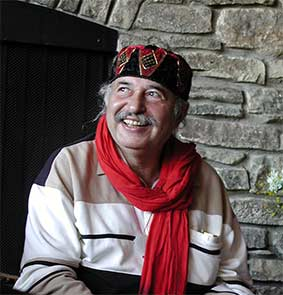
Şeyh el-Hâc el-Fakîr er-Rifâî Mehmet Şerif Çatalkaya — Sherif Baba — a sheikh of the Rifāʿī-Maʿrifī path from Istanbul, who for many years taught in the United States and Canada and whose students carry his teaching on both sides of the Atlantic.
I. Life
Sherif Baba was born in Istanbul. He began religious training at six, memorising the Qur'an, and at seventeen continued at a traditional medrese. At thirty-three, seeking a wider horizon, he found it in Sufism. In a 2000 interview he recalled growing up among teachers of the path before he went to school: his father was Naqshbandī, his mother Qādirī. Merin Shobhana Xavier's 2023 study, drawing on his translator and murid Cem Aydoğdu, adds that in Istanbul he came to know the sermons of Muzaffer Özak al-Jerrāḥī (d. 1985).
He received training in the Rifāʿī-Maʿrifī, Khalwatī, Qādirī, Bektashī, Naqshbandī and Malāmī orders in Türkiye, and is revered by his students as an eren, “one who has arrived.” His first guide was Naqshbandī; he later took the Rifāʿī path, and says he lives as a Rifāʿī. A student describes him as “very eclectic and universal, but he's also a trained imam.”
II. His murshid: Burhan Baba of İzmir
Sherif Baba named Burhan Efendi as his murshid — a bond, he said, of spiritual recognition rather than introduction. This is Burhaneddin Aktıhanoğlu, Burhan Baba (İzmir 1925 – 2002), a hotelier of Basmane who entered the Rifāʿī-Maʿrifī path in 1947 at the Entekkeliler lodge of Manisa.
He taught that religion is love — of God, people, nature, animals, plants and things, seeing God in their essence; that since everyone has faults, one should not dwell on another's; and that love of the Prophet's family must show in conduct, not only words. “Among us there is no murid and murshid,” he said: the friends loved one another for God's sake. He paid for poor children's circumcisions, found homes for the homeless, gave scholarships to orphans, and spent his hajj savings, more than once, on others.
III. New York and North Carolina
In 1991 Nur al-Jerrāḥī — Lex Hixon (d. 1995) — invited him to New York, to the Masjid al-Farah, where he served for some time as imam. In his own recollection he later taught at the Philadelphia fellowship of Bawa Muhaiyaddeen, and settled as a religious teacher. He had lived in Türkiye until 1991.
Cem Aydoğdu then invited him to North Carolina. In Chapel Hill he led the Rifai Marufi Order: in the late 1990s some thirty members, twenty of whom came to all three weekly meetings and zikr. The Rifai Marufi Order of America is registered there as a religious organisation, and the order hosted Chapel Hill's annual Rumi Festival. He lectured on spirituality and healing at universities and conferences in the United States and Canada.
IV. Vancouver, Seattle and Montreal
In 1998 Seemi Bushra Ghazi, a lecturer in Arabic at the University of British Columbia, invited him to speak at the first Rumi Festival in Vancouver. A small circle of students formed around him there. His visit led the Vancouver Turning Society to rename itself the Vancouver Rumi Society, and inspired the monthly Unity Zikr, begun that year by Ghazi, Brozak, Majid Buell and Raqib Brian Burke and still held on the last Friday of the month. Peter O'Loughlin of the Inayati Order recalls the Unity Zikr as “Sherif Baba's inspiration.”
The Vancouver circle disbanded around 2008, when most of its members moved to Seattle, where his United States branch is still based; the Rumi Festival, which had moved with the order from North Carolina, is held there each September for Rūmī's birthday. The Rumi Society of British Columbia records later visits to Vancouver in 2012 and 2014, and Vancouver's Christ Church Cathedral recalls one in 2018.
Among those who took hand with him:
- Seemi Bushra Ghazi — a student of the Rifāʿī-Maʿrifī tradition through Sherif Baba and now a shaykha in her own right; she credits him with deepening her understanding of the Qur'an.
- Majid Buell and Raqib Brian Burke, the Vancouver Rumi Society's samazenbashi.
- Tawhida Tanya Evanson, the Montreal poet and semazen, who studied fifteen years under Sherif Baba and Burke. Sema Space in Montreal exists because he gave her permission to hold sama with live music and zikr.
- Peter O'Loughlin, also initiated into the Rifāʿī-Maʿrifī through him.
V. Women on the path
Xavier's study gives Sherif Baba's circle a particular place in the story of Sufism in Canada: he treats the full participation of women — so his translator reports — as “the true tradition of Sufism and not as an innovation,” and has given women authority to lead. Evanson puts it simply: in the Rifāʿī-Maʿrifī there are no restrictions — “dervish is dervish” — and in Türkiye he is known as “the feminist shaykh.”
VI. In his words
VII. His teaching
The published conversations return to a few themes.
- First, become human. Before one can truly love God, one must clean one's thoughts and learn to be a human being; love begins with love of people.
- A living guide. Knowledge alone does not make the path; it becomes alive through an experienced teacher, who gives each student duties fitted to their growth. His students speak of real sohbet — teaching given in conversation — as the heart of it.
- One root, many branches. The orders are branches of one foundation; loud or silent zikr differ, the origin does not. Clinging to names puts rust on the mirror of the heart.
- The mirror. The seeker polishes the heart to reflect God's qualities; knowing oneself leads to knowing one's Lord.
- Forgiveness, not punishment. Where rigid religion stresses rules and penalties, Sufism stresses beautiful thoughts and forgiveness.
- Joy in discipline. Practice is lived with joy, not as rigid rule; music deepens the zikr.
- For this age. A teacher answers what people need now — peace, friendship and good conduct.
Richard Shelquist, a student of many years, writes that his teaching illuminates the heart of the message brought by the prophets and saints of all traditions, and that Sherif Baba has been his guide in understanding the Qur'an.
This page was prepared with love by his students. Corrections and additions are warmly welcome.